V
VA Home Loans for Veterans & Military Families
VA Home Loan Experts for Veterans & Military Families
Using your VA home loan benefit should not be confusing.
Veteran Community Mortgage helps Veterans, active-duty service
members and military families understand their VA home loan options,
build the right strategy and move forward with confidence from first-time
homebuying and PCS moves to refinancing, military retirement and VA construction.
⚑ VA Home Loan Education
♙20+ Years of Mortgage Experience
♡ Veteran & Military Family Focused
☆ Led by VA Loan Educator Jason Stier
VA Topics
Your VA Benefit Is More Than a Loan Program. Know How to Use It.
The VA home loan is one of the most valuable benefits earned through military service,
but the rules can feel complicated. Our job is to make them easier to understand and
help you build a strategy around your actual situation.
VA Loan Eligibility & Entitlement
Understand who is eligible, how entitlement works, whether you can use the benefit more than once and what happens when you already have a VA loan.
Buying With a VA Loan
Buying With a VA Loan
Learn how VA financing works from pre-approval through closing, including offers, closing costs, seller concessions and the VA appraisal.
PCS & Military Moves
Buying before a PCS? Deciding whether to sell or rent? Moving before the family arrives? Start with guidance built around the realities of military relocation.
Military Retirement &
VA Disability
Understand how military retirement, pending retirement and eligible VA disability income may affect your homebuying strategy and mortgage qualification.
VA Refinancing &
Assumptions
Learn how VA IRRRLs, VA cash-out refinancing and VA loan assumptions work and when each option may or may not make sense.
VA Construction Loans
Want to build instead of buy an existing home? Learn how VA construction and One-Time Close financing can work for eligible Veterans and service members.
Meet The VA Loan Boss
With over 21 years of experience in the mortgage industry, Jason Stier has built a reputation as a trusted, knowledgeable, and approachable loan officer who goes above and beyond for his clients. Known as the “VA Loan Boss,” Jason combines expertise with a deep passion for serving Veterans, military members, and their families through Veteran Community Mortgage. His mission? To ensure those who’ve served our country can navigate the path to homeownership with confidence and ease.
Jason’s years in the industry have sharpened his greatest skills: expert communication, problem-solving, and the ability to simplify complex financial processes. Whether breaking down the nuances of VA loan benefits or navigating challenging credit situations, Jason excels at turning what can feel overwhelming into an empowering experience.
When Jason isn't helping Veterans achieve their homeownership goals, he enjoys spending quality time with my family, traveling, and staying active through golf and pickleball. He's also passionate about connecting with and supporting Veteran-focused charities and organizations that make a positive impact in the lives of those who have served our country. Giving back to the Veteran community is something he values deeply, both professionally and personally.
Start With Your Situation
Where Are You in the Process?
You do not need to know every VA rule before you start. Find the situation that
looks most like yours and begin there.
I Want to Buy a Home
Understand your VA eligibility, buying power,
pre-approval and what to expect from offer to closing.
I Have PCS Orders
Build a housing strategy around your move,
timeline, current home and next duty station.
I Already Own a Home
Explore VA refinancing, assumptions, remaining entitlement and options for using your benefit again.
I Want to Build a Home
Learn how VA construction and One-Time Close
financing can help eligible borrowers finance a new build.
VA Home Loan Knowledge Center
Get Straight Answers
About the VA Home Loan
You should not have to dig through lender sales pages, social media
opinions and outdated information to understand your VA benefit.
The Veteran Community Mortgage Knowledge Center is being built to
answer the questions Veterans and military families actually ask in
plain English, with direct answers, real-world context and links to
authoritative sources when the rules matter.
The VA Process
How the VA Home Loan Process Works
Every situation is different, but most VA home purchases
move through these five stages.
Build Your Strategy
We start with your goals, military timeline, finances and how you plan to use the property.
VA Loan Pre-Approval
We review your qualification and VA eligibility so you understand your buying range before you start making offers.
Find the Right Home
You and your real estate agent search for a property that fits your needs, budget and VA financing strategy.
Appraisal & Underwriting
The property and loan are reviewed, including the VA appraisal and the documentation required for final loan approval.
Closing
Once the loan is cleared and closing requirements are satisfied, you sign the final documents and complete the purchase.
Why VCM
Why Veteran Community Mortgage?
We built Veteran Community Mortgage around a simple belief: military families
deserve more than a lender who happens to offer VA loans. They deserve
people who understand the benefit, teach the process and know the questions
to ask before problems show up.
VA-Focused Guidance
Our education, process and resources are
built around the VA home loan and the situations
military families regularly face.
Education Before Pressure
We want you to understand the benefit,
the numbers and the tradeoffs before you
make a decision.
Strategy for Real Military Life
PCS orders, deployments, retirement, disability income, existing VA loans and future moves can change the strategy. We account for the bigger picture.
I Want to Build a Home
Learn how VA construction and One-Time Close
financing can help eligible borrowers
finance a new build.
Don't take my word for it
Frequently Asked Questions
Can I use a VA loan more than once?
Yes. The VA home loan benefit can generally be used more than once. Depending on your situation, you may restore previously used entitlement or have remaining entitlement available while another VA loan is still outstanding. Your available entitlement and qualification should be reviewed for your specific scenario.
Can I have two VA loans at the same time?
It can be possible. Some eligible Veterans and service members can have more than one VA-backed loan at the same time when sufficient entitlement remains and the new loan meets applicable VA occupancy and lender qualification requirements.
Does a VA loan require a down payment?
VA-backed purchase loans can allow eligible borrowers to purchase with no down payment when the loan and borrower meet applicable VA and lender requirements. A down payment may still be required or strategically useful in certain situations.
What credit score do I need for a VA loan?
The Department of Veterans Affairs does not establish a single minimum credit score for all VA-backed loans. Lenders evaluate credit and may establish their own requirements, so qualification can vary by lender and by the overall loan profile.
What is VA loan entitlement?
VA loan entitlement is the amount of guaranty the Department of Veterans Affairs provides to an eligible borrower's VA-backed loan. Entitlement can affect how the benefit is used again, particularly when a borrower already has an outstanding VA loan or has not restored previously used entitlement.
Can VA disability income be used to qualify for a mortgage?
Eligible VA disability compensation can generally be considered as qualifying income when it is properly documented and meets applicable lending requirements. Certain non-taxable income may also receive special consideration when qualification is calculated.
What happens if I receive PCS orders after buying a home?
PCS orders do not automatically mean you must sell your home. Depending on your finances, entitlement, rental market, next duty station and long-term goals, selling, renting or keeping the property may each be worth evaluating.
Can I build a home with a VA loan?
VA-backed financing can be used for certain new-construction transactions when the borrower, property, builder and loan structure meet applicable requirements. VA construction lending is more specialized than a standard VA purchase, so the process and available loan structure should be reviewed before selecting a builder or property.
Latest Education
Latest From Veteran Community Mortgage
Clear answers, current VA guidance and practical homeownership
strategies for Veterans, service members and military families.
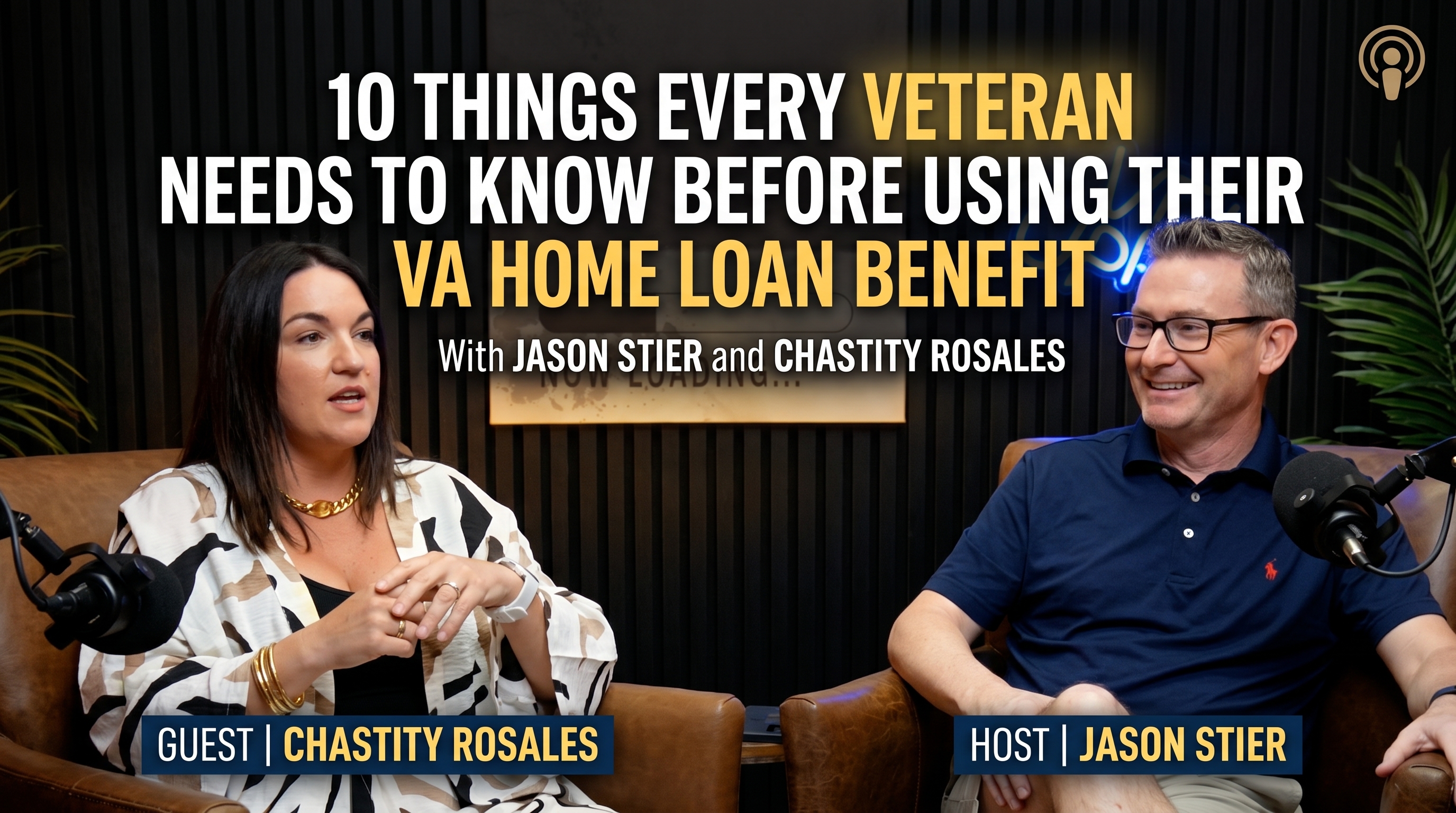
Ten Things Every Veteran Must Know Before Using Their VA Home Loan Benefit and Most Never Hear
The Benefit That Seventeen Million Veterans Have Earned and Fourteen Million Have Never Used
There are approximately seventeen million veterans in the United States. Only about three million have ever used their VA home loan benefit. Jason Stier has personally helped over a thousand veterans and active military families use that benefit. Chastity Rosales has sold over fifteen hundred homes in El Paso and works alongside military families at every stage of the buying process.
Together they sat down to go through the ten things every veteran needs to know before ever talking to a lender or a real estate agent. What follows is not a marketing pitch. It is the information that the industry too often fails to provide and that veterans deserve to have before they make one of the most significant financial decisions of their lives.
One: Eligibility Is the Starting Point and Your Lender Should Pull It for You
The first step in using the VA home loan is verifying eligibility through a Certificate of Eligibility. A competent lender can pull that in about thirty seconds. If a lender tells you to go find and pull it yourself that is a red flag.
Eligibility requirements are more nuanced than most people realize. Reserve and National Guard members have different requirements than active duty. Veterans with discharges under honorable conditions or other than honorable discharges should not assume they are ineligible without actually having someone knowledgeable look at their situation. There are conditions that may make you eligible even when you have been told otherwise.
Start with an agent who has a trusted lending partner and let that team verify eligibility before anything else moves forward.
Two: How Much House Can You Actually Afford With a VA Loan
Since the Blue Water Navy Vietnam Veterans Act passed in 2020 there is no longer a cap on the VA loan for most first-time users. You can buy as much house as you can qualify for based on your income, debt, and credit. In high-cost counties like those around San Diego and Northern Virginia the benefit extends well above conforming limits.
For veterans who have used the benefit before there are entitlement considerations that depend on how much is remaining and which county they are buying in. That calculation is manageable with the right guidance.
The bigger point Chastity makes is strategic. Do not wait until retirement to use the benefit for the first time thinking you are saving it for your forever home. Buy modestly at each duty station. The VA loan can be used more than once. Each purchase is an opportunity to build equity and generate rental income that compounds over an entire career.
Three: The VA Does Not Set a Minimum Credit Score
This is one of the most important and most misunderstood points in the entire VA loan conversation.
Chapter four of the VA's own guidelines contains zero mention of a required credit score for obtaining a VA home loan. Zero. The VA sets no credit score floor.
What does exist are lender overlays. Individual lenders set their own minimum credit score requirements because it is their money and their risk tolerance. Some lenders work with 580. Some require 620. Some set 640. That is the lender's choice, not the VA's requirement.
If you ask a loan officer or real estate agent what credit score you need to qualify for a VA loan and they use the words the VA requires they are either misinformed about the benefit or they are limiting your options based on their overlay and presenting it as a VA rule. That should prompt deeper questions. Ask whether it is a lender overlay. Ask whether other lenders in their network can go lower. And if the answer is evasive, find someone who actually knows the benefit at a deep level.
Jason also makes an important point about credit inquiries that stops many veterans from shopping their loan. Mortgage credit pulls were changed years ago. Multiple applications to different lenders for a mortgage can be treated as a single inquiry for credit scoring purposes when done within a defined window. Shopping your VA loan is not just allowed. It is encouraged. You are making a thirty-year financial commitment and you deserve to compare.
Four: Zero Down Does Not Mean Zero Cost
The VA home loan does not require a down payment but it does involve costs that veterans need to understand before they begin the process.
In Texas those costs include a third-party home inspection, a termite inspection which is required by the state, earnest money as a good faith deposit to the seller, and an option period purchase which functions as a due diligence window. Earnest money and option money sit in escrow and can be recovered if the transaction does not close under the right circumstances. Jason recently worked with a family who got a thousand dollars back at closing, effectively making the transaction zero out of pocket.
The appraisal is another cost that gets handled differently depending on how the transaction is structured. Sometimes it is paid upfront. Sometimes it is collected at closing. Sometimes the seller covers it as part of closing cost negotiations.
The critical distinction that Jason emphasizes is the difference between closing costs and concessions on a VA loan. This is unique to the VA program. Seller concessions on a VA loan can be used to pay down debt, cover the funding fee, or buy down the interest rate. That is separate from closing costs the seller can also agree to cover. Understanding how to use both tools strategically can make the transaction significantly more affordable and in some cases help the veteran qualify who otherwise might not.
He gave a specific example. A veteran was selling a home and coming from Fort Campbell with $35,000 in equity and a car loan carrying a $700 monthly payment. Conventional thinking said put the equity toward the new home. The better strategy was to pay off the car, eliminate $700 per month from the debt-to-income calculation, and qualify for more home with a lower effective debt load. Every thousand dollars applied to a down payment reduces the monthly mortgage payment by approximately six dollars. Paying off a $700 monthly car payment produces $700 of monthly qualification headroom. The math is not close.
Five: Why Some Sellers and Agents Resist VA Loans and Why They Are Wrong
The resistance exists. Sellers and listing agents who say they prefer conventional offers over VA offers are often operating on misinformation that is twenty years old.
The claim that VA appraisals are more conservative than conventional appraisals is not supported by how appraisals actually work. Every appraiser uses the same valuation methodology regardless of loan type. The lender, not the loan type, is protecting the bank's asset in every transaction. The appraisal process does not change based on whether the buyer is using VA, FHA, or conventional financing.
What does differ slightly is minimum property requirements. The VA has specific guidelines around certain property conditions including peeling paint on homes built before 1978. Those guidelines have been updated and most agents teaching VA appraisal classes have found that virtually no one in the room had heard about the changes. If agents are going to work with military families it is their responsibility to know the current guidelines, not the ones that applied twenty years ago.
The claim that zero down means no skin in the game is the one that Jason addresses most directly. Service is skin in the game. Time away from family is skin in the game. Raising your hand to serve in the one percent of Americans who do that is skin in the game. The VA home loan benefit exists because of that service and questioning whether a VA buyer is committed enough because they are not putting cash down misunderstands the entire program.
Sellers who want a stronger offer should ask for stronger earnest money. A properly protected offer with an appraisal contingency does not become significantly weaker or stronger based on down payment. The appraisal contingency protects the buyer regardless of loan type. The earnest money is what a seller actually gets to keep if a buyer backs out without cause.
Six: How to Make a VA Offer More Competitive
There is no blanket answer because competitiveness is situational. A house that has been on the market for sixty days with no other offers requires a completely different approach than a hot listing with three offers already in hand.
What Chastity and Jason do consistently is call the listing agent before submitting an offer and ask directly what the seller needs. Timeline matters as much as price in many situations. A military family PCSing out in ninety days may not want to close and vacate immediately. Understanding what the seller actually wants rather than assuming price is everything produces competitive offers that win on the right terms.
Educating the listing agent about VA loans is also part of the process. If the concern is about appraisal requirements or property condition guidelines an agent who has taught seven VA appraisal classes since the most recent guideline changes has the ability to address those concerns directly and honestly.
Eighty-seven percent of buyers hire the first agent they talk to and rarely ask the questions that would reveal whether that agent can actually protect them. Ask how they handle multiple offer situations. Ask what happens if there is an appraisal issue. Ask how many VA transactions they have closed. And recognize that a newer agent with a strong mentor may be a better choice than an experienced agent who does not understand the VA benefit.
Seven: The Average Loan Officer Closes Four VA Loans Per Year
That number is from current industry data. Four VA loans per year is not enough volume to develop the expertise that military families need when navigating a benefit that has specific guidelines, entitlement calculations, PCS timing considerations, and appraisal requirements that differ from conventional lending.
When choosing a lender ask how many VA transactions they close annually. Ask about their experience with active duty buyers coming from overseas. Ask what their process looks like for the appraisal. Ask whether they understand PCS cycles and TMO and household goods delivery timelines because those realities affect how and when a transaction needs to close.
The largest national brands that market heavily to veterans are private companies. The VA does not have a lending division. Every lender you see advertising to veterans is a for-profit business marketing to a specific demographic. Some of them are excellent. Some of them build their overhead into their rates and fees. Knowing who you are working with and why matters.
Eight: You Can Use Your VA Loan More Than Once and You Can Have More Than One VA Loan at a Time
Both of these facts are unknown to most veterans. Entitlement is the mechanism that governs how much VA loan capacity a veteran has available. When a VA loan is paid off through sale or refinance the entitlement can be restored. There is also a one-time restoration option for veterans who want to keep a property and restore full entitlement for a new purchase.
For most of the country the first tier of entitlement supports a purchase around $836,000 with zero down. In high-cost counties it goes significantly higher.
The wealth-building application of this benefit across a career is one of the most underutilized opportunities in personal finance for active duty service members. Buy at each duty station. Rent the property when you PCS. Over a twenty-year career with smart purchases at multiple duty stations a veteran could have twelve to fourteen properties with other people paying the mortgages. The equity accumulated across that portfolio is a retirement strategy that requires no additional cash investment beyond the service itself.
The quadplex is the highest-leverage application. Buying a four-unit property with a VA loan, living in one unit, and renting the other three means the rental income from three units can cover or come close to covering the entire mortgage payment. When you PCS or separate from service you own a four-unit income-producing property that you acquired with zero down payment. A conventional investor would have paid twenty-five percent down for the same asset.
Nine: Should You Buy if You Know You Are Going to PCS
The answer depends on your specific situation and no one should push you either way without actually assessing that situation.
The calculation involves how long you will be at the duty station, what the local property tax rate is, what the realistic rent range is if you convert the property to a rental when you leave, and whether you could refinance before the PCS to improve the cash flow position if rates improve.
In high property tax markets like Texas cash flow after converting to a rental is genuinely difficult to achieve at current rates. That does not mean buying is wrong. It means the conversation needs to be honest about the numbers rather than enthusiastic about the concept.
Some military buyers choose to absorb a small monthly loss on a rental because they view it as an investment in an appreciating asset that someone else is partially funding. That can be a reasonable choice. It needs to be an informed one. The house hacking alternative, buying a multi-unit property or a larger single-family home with extra bedrooms and renting rooms to other service members, can make the numbers work even in high-cost or high-tax markets.
Ten: How to Choose the Right VA Lender and Real Estate Agent
Start with experience. How many VA loans has this loan officer closed in the past year? How many homes has this agent sold to military families? Can they show you their closing history? Do they have Google reviews that reflect a pattern of serving this community well?
Experience alone is not the only measure. A newer agent with a strong mentor behind every deal may be better positioned to protect you than a veteran agent who stopped learning about VA guidelines years ago. Ask who is behind them. Ask what happens if something goes wrong.
The questions to ask a lender go beyond the rate. What is their process for the appraisal? How do they handle PCS-related timing? Do they understand entitlement calculations for veterans who have used the benefit before? Have they worked with buyers coming from overseas assignments?
And perhaps most importantly, a great agent who truly knows the VA benefit will have lender partners they have personally vetted. That relationship between agent and lender is not just convenient. It is the ecosystem that makes complex transactions involving military buyers work. Communication, trust, and shared accountability across the entire transaction is what separates a smooth closing from a painful one.
The One Piece of Advice Worth Internalizing Before Anything Else
BAH equals buy a house. Your Basic Allowance for Housing is a monthly payment from the government specifically designated for your housing cost. At $1,200 per month that is $24,000 per year. Over three years it is over $80,000. Every dollar of that BAH that goes toward someone else's mortgage is $80,000 over three years building equity for a landlord who mastered exactly what this conversation is about.
The VA home loan is the mechanism that allows you to deploy that monthly housing allowance toward an asset you own rather than an asset you are helping someone else own. The process is not as complicated as most people believe. The greatest obstacle to VA home loan utilization is not the guidelines, not the interest rates, not the income requirements. It is lack of education.
You now have more of that education than most veterans receive before they buy their first home.
Share this with anyone you know who has served. Ask your questions in the comments. If you are buying in any state Jason Stier can help and Chastity Rosales has partners everywhere. It is time to use the benefit you earned.
Sources
VA.gov
MilitaryOneSource.mil
ConsumerFinancialProtectionBureau.gov
MortgageNewsDaily.com
NAR.realtor

Mortgage Calculator
See your total mortgage payments using the tool below.
| Year | Interest | Principal | Balance |
|---|
Have a VA Loan Question?
Start With the Strategy.
You do not need to figure out the VA home loan on your own. Whether you are
buying, refinancing, PCSing, retiring from the military or planning a new
construction home, start by understanding your options and the next step that
makes sense for your situation.