
VA Home Loan Guidance for Veterans, Active Duty Military, and Their Families
From eligibility to closing, get expert VA loan guidance designed to help you use the benefits you earned.
Meet The VA Loan Boss
With over 21 years of experience in the mortgage industry, Jason Stier has built a reputation as a trusted, knowledgeable, and approachable loan officer who goes above and beyond for his clients. Known as the “VA Loan Boss,” Jason combines expertise with a deep passion for serving Veterans, military members, and their families through Veteran Community Mortgage. His mission? To ensure those who’ve served our country can navigate the path to homeownership with confidence and ease.
Jason’s years in the industry have sharpened his greatest skills: expert communication, problem-solving, and the ability to simplify complex financial processes. Whether breaking down the nuances of VA loan benefits or navigating challenging credit situations, Jason excels at turning what can feel overwhelming into an empowering experience.
When Jason isn't helping Veterans achieve their homeownership goals, he enjoys spending quality time with my family, traveling, and staying active through golf and pickleball. He's also passionate about connecting with and supporting Veteran-focused charities and organizations that make a positive impact in the lives of those who have served our country. Giving back to the Veteran community is something he values deeply, both professionally and personally.
The VA Home Loan Process
Mortgage Pre-Approval
Get pre-approved from me to see how much you can afford.
House Shopping
Work with a trusted Real Estate Agent to find a home you would like to move into.
Loan Application
Complete your home loan application to get the lending process started.
Don't take my word for it
Mortgage Programs
Experience the best mortgage experience located in Texas.
Home Loan Options
Our experienced mortgage advisors will walk you through the best mortgage loan program that will fit your specific scenario.
Conventional Home Loans.
FHA Home Loans.
USDA Home Loans.
VA Home Loans.
Frequently Asked Questions
How often can I refinance my mortgage?
There is no limit to the number of times you can refinance. However, you must qualify every time you apply and there will be costs associated with closing the loan each time.
Can I buy a home if I do not have money for a down payment?
Yes! There are a number of bond programs that offer low or no down payment financing options.
How do I know which mortgage is right for me?
The key to choosing the right mortgage is to understand the range of options and features available to you, as well as your budget, circumstances, and goals. Our licensed mortgage professionals are here to help you navigate that process. The more you know, the more comfortable and confident you will be choosing the best option for you and your family.
How long will the loan process take?
The Truth in Lending Act (TILA) does not permit a lender to close a loan until at least seven (7) business days have passed from the date your application was received. A typical home loan takes 30 days, as a number of third-party services such as appraisals, title work, and credit are required in conjunction with the mortgage process. Once you familiarize your Loan Officer with the details of your specific loan scenario, they will be able to provide you with a more specific timeline.
Will I qualify for a home loan?
The only way to find out is to speak with a qualified mortgage professional. Our Loan Officers have helped numerous clients who didn’t know if they could qualify to become home owners. We take the time to understand your financial situation and long-term financial goals, and then match you with the loan program that best fits your needs. Your approval for a loan may also largely depend on the price of the home you are financing. Getting pre-qualified prior to beginning your home search can give you an idea of what you may be able to afford.
Why do people refinance their mortgages?
Homeowners typically refinance to save money, either by obtaining a lower interest rate or by reducing the term of their loan. Refinancing is also a way to convert an adjustable loan to a fixed loan or to consolidate debts.
How much money will I have to pay upfront to buy a home?
This question does not have a simple, one-size-fits-all answer. The exact amount will depend on the price of the home you buy as well the type of mortgage financing you choose. Depending on your loan program, your down payment could be as much as 20% of the home’s price or as little as 3%, while some loans require no down payment at all.
Can I get a mortgage after bankruptcy?
You may still qualify for a home loan even if you have experienced a bankruptcy. The best way to find out if you qualify is to talk with a Loan Officer to discuss your options. Be sure to bring all paperwork regarding your bankruptcy so your Loan Officer can find the program that best fits your situation.
Should I lock my interest rate now, or wait until we are closer to our closing?
Interest rates fluctuate all day, every day. If an interest rate is good, it may be in your best interest to lock now. If you wait, you run the risk of an increase in rates later. If you are concerned that rates may go down after you lock, contact your Loan Officer to discuss your options. Some programs allow you to lock for an extended period and choose to lower your rate should a better one become available.
Most Recent Blog Updates
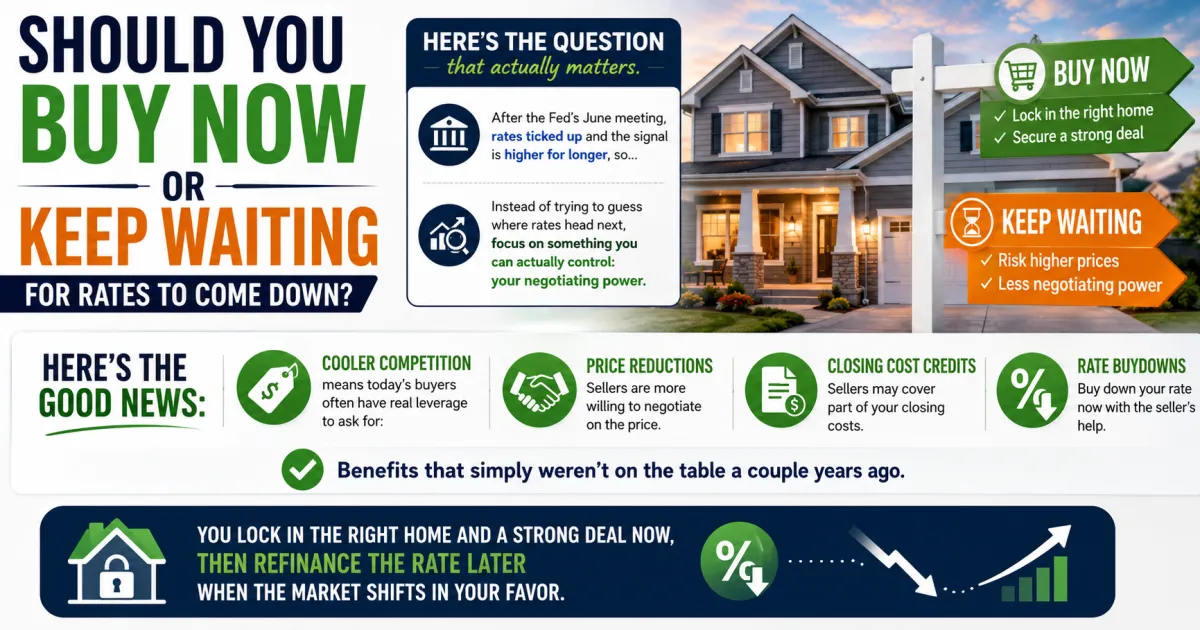
Stop Trying to Predict Rates and Start Using the Negotiating Power You Actually Have Right Now
The Question That Matters More Than Where Rates Are Going
Should you buy now or keep waiting for rates to come down? It is the question buyers keep asking and the honest answer starts with redirecting the focus entirely.
After the Fed's June meeting rates ticked up and the signal coming from the Fed is higher for longer. Trying to predict when rates will meaningfully improve based on Fed meeting calendars is not a reliable strategy. The Fed controls short-term rates and mortgage rates respond to a much broader set of global and economic factors that no one can forecast with precision on any specific timeline.
So instead of trying to guess where rates head next focus on something you can actually control.
The Negotiating Power That Exists Right Now
Cooler competition in the current market is creating real leverage for buyers that was simply not available one or two years ago. When multiple offers were happening on every listing sellers did not need to offer anything beyond accepting the highest price. That dynamic has shifted.
Today's buyers are regularly capturing price reductions on homes that have been sitting. Closing cost credits from sellers that reduce the upfront cash required to close. Seller-funded rate buydowns that lower the monthly payment from day one. Longer escrow timelines that accommodate the buyer's situation rather than the seller's urgency.
As Jason Stier explains those tools were not on the table a couple of years ago. They are on the table now and buyers who know how to ask for them are capturing meaningful financial benefit that offsets a meaningful portion of the rate environment's impact on their monthly payment.
The Strategy That Makes the Math Work
Here is the framework that changes how the buy now versus wait decision looks when the full picture is considered.
You lock in the right home and a strong deal now. You negotiate the seller concessions that reduce your upfront costs and improve your starting payment. You own the home while it continues to appreciate. You build equity from the first payment forward. And when the rate environment shifts in your favor you refinance into a lower rate.
The rate is refinanceable. The home you did not buy because you were waiting is not.
Buyers who wait for rates to improve before entering the market are waiting for the moment when every other buyer who has been sitting on the sidelines comes back simultaneously. That surge in demand against constrained supply pushes prices higher and the negotiating leverage that exists today disappears. You may end up with a better rate and a more expensive home with less room to negotiate the terms that matter.
The buyers who are positioned best are the ones who act when leverage is available and refinance when rates improve. Both of those things can happen. Only one of them requires the market to cooperate on your preferred timeline.
Jason Stier works with buyers to evaluate their specific situation and build a purchasing strategy that captures the negotiating advantages available in the current market. Reach out to Jason Stier to find out what the numbers look like for your situation right now.
Sources
FederalReserve.gov
MortgageNewsDaily.com
NAR.realtor
BankRate.com
Investopedia.com

Mortgage Calculator
See your total mortgage payments using the tool below.
| Year | Interest | Principal | Balance |
|---|