
VA Home Loan Guidance for Veterans, Active Duty Military, and Their Families
From eligibility to closing, get expert VA loan guidance designed to help you use the benefits you earned.
Meet The VA Loan Boss
With over 21 years of experience in the mortgage industry, Jason Stier has built a reputation as a trusted, knowledgeable, and approachable loan officer who goes above and beyond for his clients. Known as the “VA Loan Boss,” Jason combines expertise with a deep passion for serving Veterans, military members, and their families through Veteran Community Mortgage. His mission? To ensure those who’ve served our country can navigate the path to homeownership with confidence and ease.
Jason’s years in the industry have sharpened his greatest skills: expert communication, problem-solving, and the ability to simplify complex financial processes. Whether breaking down the nuances of VA loan benefits or navigating challenging credit situations, Jason excels at turning what can feel overwhelming into an empowering experience.
When Jason isn't helping Veterans achieve their homeownership goals, he enjoys spending quality time with my family, traveling, and staying active through golf and pickleball. He's also passionate about connecting with and supporting Veteran-focused charities and organizations that make a positive impact in the lives of those who have served our country. Giving back to the Veteran community is something he values deeply, both professionally and personally.
The VA Home Loan Process
Mortgage Pre-Approval
Get pre-approved from me to see how much you can afford.
House Shopping
Work with a trusted Real Estate Agent to find a home you would like to move into.
Loan Application
Complete your home loan application to get the lending process started.
Don't take my word for it
Mortgage Programs
Experience the best mortgage experience located in Texas.
Home Loan Options
Our experienced mortgage advisors will walk you through the best mortgage loan program that will fit your specific scenario.
Conventional Home Loans.
FHA Home Loans.
USDA Home Loans.
VA Home Loans.
Frequently Asked Questions
How often can I refinance my mortgage?
There is no limit to the number of times you can refinance. However, you must qualify every time you apply and there will be costs associated with closing the loan each time.
Can I buy a home if I do not have money for a down payment?
Yes! There are a number of bond programs that offer low or no down payment financing options.
How do I know which mortgage is right for me?
The key to choosing the right mortgage is to understand the range of options and features available to you, as well as your budget, circumstances, and goals. Our licensed mortgage professionals are here to help you navigate that process. The more you know, the more comfortable and confident you will be choosing the best option for you and your family.
How long will the loan process take?
The Truth in Lending Act (TILA) does not permit a lender to close a loan until at least seven (7) business days have passed from the date your application was received. A typical home loan takes 30 days, as a number of third-party services such as appraisals, title work, and credit are required in conjunction with the mortgage process. Once you familiarize your Loan Officer with the details of your specific loan scenario, they will be able to provide you with a more specific timeline.
Will I qualify for a home loan?
The only way to find out is to speak with a qualified mortgage professional. Our Loan Officers have helped numerous clients who didn’t know if they could qualify to become home owners. We take the time to understand your financial situation and long-term financial goals, and then match you with the loan program that best fits your needs. Your approval for a loan may also largely depend on the price of the home you are financing. Getting pre-qualified prior to beginning your home search can give you an idea of what you may be able to afford.
Why do people refinance their mortgages?
Homeowners typically refinance to save money, either by obtaining a lower interest rate or by reducing the term of their loan. Refinancing is also a way to convert an adjustable loan to a fixed loan or to consolidate debts.
How much money will I have to pay upfront to buy a home?
This question does not have a simple, one-size-fits-all answer. The exact amount will depend on the price of the home you buy as well the type of mortgage financing you choose. Depending on your loan program, your down payment could be as much as 20% of the home’s price or as little as 3%, while some loans require no down payment at all.
Can I get a mortgage after bankruptcy?
You may still qualify for a home loan even if you have experienced a bankruptcy. The best way to find out if you qualify is to talk with a Loan Officer to discuss your options. Be sure to bring all paperwork regarding your bankruptcy so your Loan Officer can find the program that best fits your situation.
Should I lock my interest rate now, or wait until we are closer to our closing?
Interest rates fluctuate all day, every day. If an interest rate is good, it may be in your best interest to lock now. If you wait, you run the risk of an increase in rates later. If you are concerned that rates may go down after you lock, contact your Loan Officer to discuss your options. Some programs allow you to lock for an extended period and choose to lower your rate should a better one become available.
Most Recent Blog Updates
New Credit Scoring Models Are Now Allowed for Mortgages and Here Is What That Means for Buyers
The Credit Scoring Change That Could Open the Door for Millions of Buyers
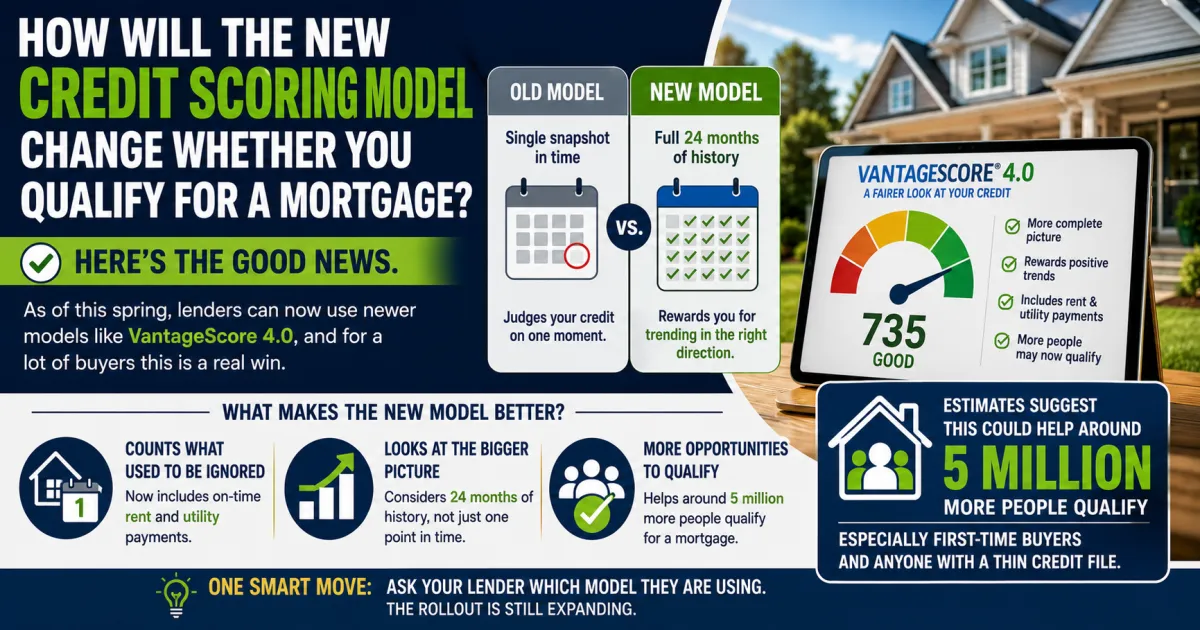
As of this spring lenders can now use newer credit scoring models like VantageScore 4.0 when evaluating mortgage applications. For a significant number of buyers this is genuinely good news and understanding what changed and why it matters could be the difference between a decline and an approval.
What Was Wrong With the Old System
The traditional credit scoring model that has governed mortgage qualification for decades evaluates your credit based on a single snapshot in time. What your balances look like today. What your payment history shows at the moment the report is pulled. The direction you have been moving and the progress you have been making does not factor into the picture in any meaningful way.
That static snapshot approach creates real problems for buyers who are actively improving their financial position. A borrower who has been steadily paying down a credit card balance over twelve months of consistent effort looks essentially the same to the old model as a borrower who has been sitting at that same balance the entire time. The trend is invisible. Only the current state matters.
What the New Models Do Differently
VantageScore 4.0 and the newer scoring frameworks look at a full 24 months of credit history rather than a single point in time. That extended window allows the model to see and reward borrowers who are trending in the right direction. Steadily paying down a balance. Consistently making payments on time after a difficult period. Building a responsible credit pattern over time rather than simply arriving at a snapshot that happens to look good.
As Jason Stier explains this is a meaningful improvement for buyers who have been working to improve their credit and whose trajectory tells a better story than their current balance sheet does in isolation.
The second change is arguably even more impactful for certain buyers. The newer models can count on-time rent payments and utility payments toward credit history in ways that the old model ignored entirely. For first-time buyers and anyone with a thin credit file this is significant. Someone who has been paying rent reliably for years has been demonstrating creditworthiness consistently. Under the old system that history was invisible to mortgage underwriting. Under the new models it can count.
How Many Buyers This Could Help
Estimates suggest that the transition to newer scoring models could help approximately 5 million more people qualify for a mortgage. That number reflects the population of buyers whose credit history tells a better story under a 24-month trending model than it does under a static snapshot and buyers whose on-time rent and utility payments have been building a creditworthiness record that was previously uncountable.
First-time buyers are disproportionately represented in that population. So are buyers with thin credit files who have been responsible with the obligations they carry but have not yet built an extensive traditional credit history.
The One Question Worth Asking Your Lender Right Now
The rollout of these newer scoring models is still expanding and not every lender is using them yet. The old models remain in use at many institutions and the transition is not uniform across the mortgage industry.
The smart move is simply to ask your lender which credit scoring model they are using on your application. If they are still using the older model and you have a history of on-time rent or utility payments or you have been trending in a positive direction on your balances it may be worth asking whether a lender using VantageScore 4.0 or a comparable newer model produces a different qualification picture for your specific file.
Jason Stier works with buyers to navigate credit qualification and identify which lending approach produces the best outcome for their specific situation. Reach out to Jason Stier to find out how the new scoring models might affect what you qualify for right now.
Sources
ConsumerFinancialProtectionBureau.gov
FannieMae.com
MyFICO.com
MortgageNewsDaily.com
Investopedia.com

Mortgage Calculator
See your total mortgage payments using the tool below.
| Year | Interest | Principal | Balance |
|---|