VA Home Loan Guidance for Veterans, Active Duty Military, and Their Families
From eligibility to closing, get expert VA loan guidance designed to help you use the benefits you earned.
Meet The VA Loan Boss
With over 21 years of experience in the mortgage industry, Jason Stier has built a reputation as a trusted, knowledgeable, and approachable loan officer who goes above and beyond for his clients. Known as the “VA Loan Boss,” Jason combines expertise with a deep passion for serving Veterans, military members, and their families through Veteran Community Mortgage. His mission? To ensure those who’ve served our country can navigate the path to homeownership with confidence and ease.
Jason’s years in the industry have sharpened his greatest skills: expert communication, problem-solving, and the ability to simplify complex financial processes. Whether breaking down the nuances of VA loan benefits or navigating challenging credit situations, Jason excels at turning what can feel overwhelming into an empowering experience.
When Jason isn't helping Veterans achieve their homeownership goals, he enjoys spending quality time with my family, traveling, and staying active through golf and pickleball. He's also passionate about connecting with and supporting Veteran-focused charities and organizations that make a positive impact in the lives of those who have served our country. Giving back to the Veteran community is something he values deeply, both professionally and personally.
The VA Home Loan Process
Mortgage Pre-Approval
Get pre-approved from me to see how much you can afford.
House Shopping
Work with a trusted Real Estate Agent to find a home you would like to move into.
Loan Application
Complete your home loan application to get the lending process started.
Don't take my word for it
Mortgage Programs
Experience the best mortgage experience located in Texas.
Home Loan Options
Our experienced mortgage advisors will walk you through the best mortgage loan program that will fit your specific scenario.
Conventional Home Loans.
FHA Home Loans.
USDA Home Loans.
VA Home Loans.
Frequently Asked Questions
How often can I refinance my mortgage?
There is no limit to the number of times you can refinance. However, you must qualify every time you apply and there will be costs associated with closing the loan each time.
Can I buy a home if I do not have money for a down payment?
Yes! There are a number of bond programs that offer low or no down payment financing options.
How do I know which mortgage is right for me?
The key to choosing the right mortgage is to understand the range of options and features available to you, as well as your budget, circumstances, and goals. Our licensed mortgage professionals are here to help you navigate that process. The more you know, the more comfortable and confident you will be choosing the best option for you and your family.
How long will the loan process take?
The Truth in Lending Act (TILA) does not permit a lender to close a loan until at least seven (7) business days have passed from the date your application was received. A typical home loan takes 30 days, as a number of third-party services such as appraisals, title work, and credit are required in conjunction with the mortgage process. Once you familiarize your Loan Officer with the details of your specific loan scenario, they will be able to provide you with a more specific timeline.
Will I qualify for a home loan?
The only way to find out is to speak with a qualified mortgage professional. Our Loan Officers have helped numerous clients who didn’t know if they could qualify to become home owners. We take the time to understand your financial situation and long-term financial goals, and then match you with the loan program that best fits your needs. Your approval for a loan may also largely depend on the price of the home you are financing. Getting pre-qualified prior to beginning your home search can give you an idea of what you may be able to afford.
Why do people refinance their mortgages?
Homeowners typically refinance to save money, either by obtaining a lower interest rate or by reducing the term of their loan. Refinancing is also a way to convert an adjustable loan to a fixed loan or to consolidate debts.
How much money will I have to pay upfront to buy a home?
This question does not have a simple, one-size-fits-all answer. The exact amount will depend on the price of the home you buy as well the type of mortgage financing you choose. Depending on your loan program, your down payment could be as much as 20% of the home’s price or as little as 3%, while some loans require no down payment at all.
Can I get a mortgage after bankruptcy?
You may still qualify for a home loan even if you have experienced a bankruptcy. The best way to find out if you qualify is to talk with a Loan Officer to discuss your options. Be sure to bring all paperwork regarding your bankruptcy so your Loan Officer can find the program that best fits your situation.
Should I lock my interest rate now, or wait until we are closer to our closing?
Interest rates fluctuate all day, every day. If an interest rate is good, it may be in your best interest to lock now. If you wait, you run the risk of an increase in rates later. If you are concerned that rates may go down after you lock, contact your Loan Officer to discuss your options. Some programs allow you to lock for an extended period and choose to lower your rate should a better one become available.
Most Recent Blog Updates
How the Iran Conflict Pushed Mortgage Rates to 6.75 Percent and Why the Peace Deal Is Bringing Relief
The Chain Reaction That Has Been Moving Your Mortgage Rate Since February
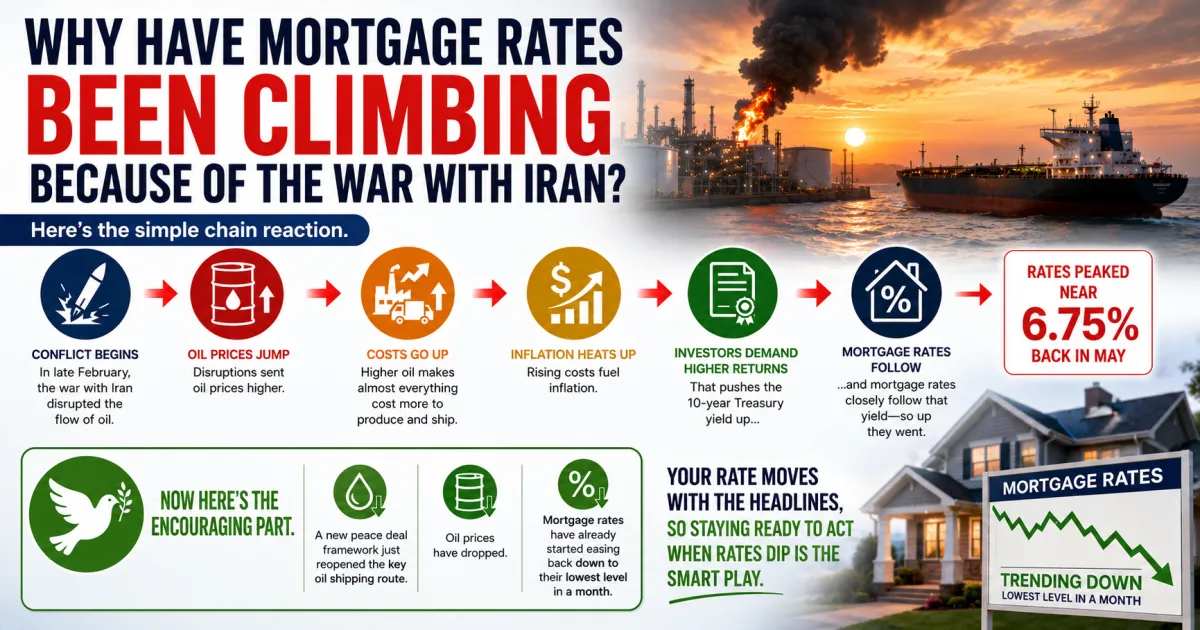
If mortgage rates have felt like they were responding to global headlines rather than anything happening domestically over the past several months that is exactly what has been driving them. The connection between the Iran conflict and the rate being quoted to buyers and veterans right now is direct and worth understanding clearly because knowing the mechanism is what allows you to position yourself to act when the window opens.
How the Conflict Pushed Rates Higher
When combat operations began in late February they disrupted the flow of oil through the region. Oil prices jumped in response to that supply disruption. Everything we produce and ship has oil embedded in its cost and when oil prices rise that broad-based cost increase feeds directly into inflation across the entire economy.
When inflation heats up investors who hold bonds demand higher returns to protect against the purchasing power erosion that inflation creates. That demand pushed the ten-year Treasury yield above the 4.45 mark and at times above 4.50. Mortgage rates follow that yield closely and rates climbed alongside it peaking near 6.75 percent on the conforming side. VA rates ran somewhat lower as they typically do reflecting the government backing that makes VA loans less risky for investors.
Why Rates Are Starting to Ease
The memorandum of understanding peace framework has reopened the Strait of Hormuz and oil is no longer being disrupted in the same way. Oil prices have come back down to approximately $68 a barrel. That reduction in energy cost eases the inflationary pressure that was pushing bond yields higher and mortgage rates are starting to follow yields back down toward their lowest levels in the past month.
As Jason Stier explains your rate moves with the headlines. The conflict pushed rates up. The peace framework is pulling them back down. Whether that easing continues depends entirely on whether the framework holds and the strait stays open. The situation is still developing and nothing about geopolitical stability should be assumed to be permanent.
Why This Moment Matters Especially for VA Borrowers
For veterans and active duty service members the current environment creates a specific and compelling opportunity that Jason Stier wants to make sure the VA community understands clearly.
VA Interest Rate Reduction Refinance Loans are one of the most streamlined refinance products available anywhere in the mortgage market. When rates ease from a recent peak VA borrowers who purchased or last refinanced at higher rates have an efficient path to capturing the improvement without the full documentation burden of a conventional refinance.
For VA borrowers carrying high-rate consumer debt a VA cash-out refinance in a period of easing rates is an especially powerful combination. The VA program allows eligible veterans to access their home equity through a cash-out refinance and use those funds to pay off credit card balances, personal loans, and other high-rate obligations. Restructuring that debt into a VA mortgage at current rates while rates are easing from a peak produces meaningful monthly cash flow improvement for borrowers who have been carrying expensive consumer debt alongside their mortgage.
Staying Ready to Act Is the Smart Play
Rates move with headlines and in the current environment those headlines can shift the rate environment meaningfully in either direction with very little warning. Buyers and veterans who are pre-approved and positioned to move when rates dip capture the improvement. Those who are still working through the early stages of the process when the window opens often find it has closed before they can act.
Jason Stier works with VA borrowers and conventional buyers to stay informed about rate movements and to be positioned to act when the market creates the right opportunity. Reach out to Jason Stier to find out what the current rate environment means for your specific situation and how to make sure you are ready when the next favorable window appears.
Sources
VA.gov
FederalReserve.gov
TreasuryDirect.gov
MortgageNewsDaily.com
EnergyInformationAdministration.gov

Mortgage Calculator
See your total mortgage payments using the tool below.
| Year | Interest | Principal | Balance |
|---|