
VA Home Loan Guidance for Veterans, Active Duty Military, and Their Families
From eligibility to closing, get expert VA loan guidance designed to help you use the benefits you earned.
Meet The VA Loan Boss
With over 21 years of experience in the mortgage industry, Jason Stier has built a reputation as a trusted, knowledgeable, and approachable loan officer who goes above and beyond for his clients. Known as the “VA Loan Boss,” Jason combines expertise with a deep passion for serving Veterans, military members, and their families through Veteran Community Mortgage. His mission? To ensure those who’ve served our country can navigate the path to homeownership with confidence and ease.
Jason’s years in the industry have sharpened his greatest skills: expert communication, problem-solving, and the ability to simplify complex financial processes. Whether breaking down the nuances of VA loan benefits or navigating challenging credit situations, Jason excels at turning what can feel overwhelming into an empowering experience.
When Jason isn't helping Veterans achieve their homeownership goals, he enjoys spending quality time with my family, traveling, and staying active through golf and pickleball. He's also passionate about connecting with and supporting Veteran-focused charities and organizations that make a positive impact in the lives of those who have served our country. Giving back to the Veteran community is something he values deeply, both professionally and personally.
The VA Home Loan Process
Mortgage Pre-Approval
Get pre-approved from me to see how much you can afford.
House Shopping
Work with a trusted Real Estate Agent to find a home you would like to move into.
Loan Application
Complete your home loan application to get the lending process started.
Don't take my word for it
Mortgage Programs
Experience the best mortgage experience located in Texas.
Home Loan Options
Our experienced mortgage advisors will walk you through the best mortgage loan program that will fit your specific scenario.
Conventional Home Loans.
FHA Home Loans.
USDA Home Loans.
VA Home Loans.
Frequently Asked Questions
How often can I refinance my mortgage?
There is no limit to the number of times you can refinance. However, you must qualify every time you apply and there will be costs associated with closing the loan each time.
Can I buy a home if I do not have money for a down payment?
Yes! There are a number of bond programs that offer low or no down payment financing options.
How do I know which mortgage is right for me?
The key to choosing the right mortgage is to understand the range of options and features available to you, as well as your budget, circumstances, and goals. Our licensed mortgage professionals are here to help you navigate that process. The more you know, the more comfortable and confident you will be choosing the best option for you and your family.
How long will the loan process take?
The Truth in Lending Act (TILA) does not permit a lender to close a loan until at least seven (7) business days have passed from the date your application was received. A typical home loan takes 30 days, as a number of third-party services such as appraisals, title work, and credit are required in conjunction with the mortgage process. Once you familiarize your Loan Officer with the details of your specific loan scenario, they will be able to provide you with a more specific timeline.
Will I qualify for a home loan?
The only way to find out is to speak with a qualified mortgage professional. Our Loan Officers have helped numerous clients who didn’t know if they could qualify to become home owners. We take the time to understand your financial situation and long-term financial goals, and then match you with the loan program that best fits your needs. Your approval for a loan may also largely depend on the price of the home you are financing. Getting pre-qualified prior to beginning your home search can give you an idea of what you may be able to afford.
Why do people refinance their mortgages?
Homeowners typically refinance to save money, either by obtaining a lower interest rate or by reducing the term of their loan. Refinancing is also a way to convert an adjustable loan to a fixed loan or to consolidate debts.
How much money will I have to pay upfront to buy a home?
This question does not have a simple, one-size-fits-all answer. The exact amount will depend on the price of the home you buy as well the type of mortgage financing you choose. Depending on your loan program, your down payment could be as much as 20% of the home’s price or as little as 3%, while some loans require no down payment at all.
Can I get a mortgage after bankruptcy?
You may still qualify for a home loan even if you have experienced a bankruptcy. The best way to find out if you qualify is to talk with a Loan Officer to discuss your options. Be sure to bring all paperwork regarding your bankruptcy so your Loan Officer can find the program that best fits your situation.
Should I lock my interest rate now, or wait until we are closer to our closing?
Interest rates fluctuate all day, every day. If an interest rate is good, it may be in your best interest to lock now. If you wait, you run the risk of an increase in rates later. If you are concerned that rates may go down after you lock, contact your Loan Officer to discuss your options. Some programs allow you to lock for an extended period and choose to lower your rate should a better one become available.
Most Recent Blog Updates
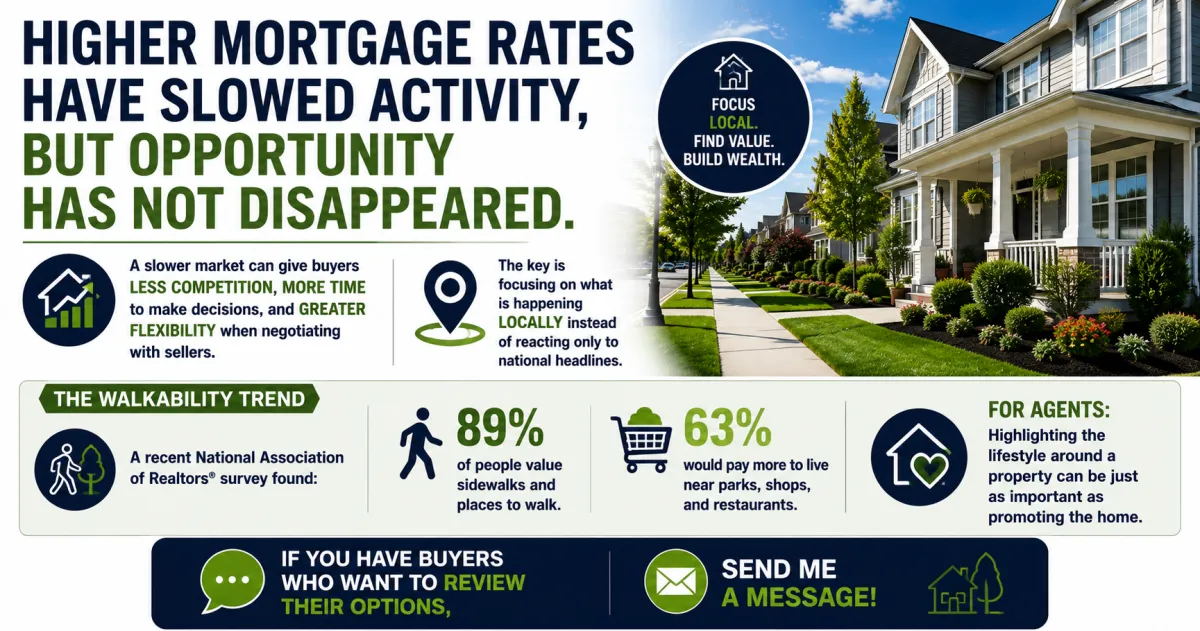
A Slower Mortgage Market Creates Real Buyer Opportunity and Walkability Is Now Driving Decisions
Why a Slower Market Is Not the Same as a Bad Market
Higher mortgage rates have slowed some activity in the housing market. That is true and it is worth acknowledging directly. But a slower market and a market without opportunity are not the same thing and buyers who understand the difference are positioning themselves well right now while others sit on the sidelines waiting for conditions that feel more comfortable.
What a Slower Market Actually Gives Buyers
When transaction volume slows several things change in the buyer's favor simultaneously.
Less competition. In the peak years of the market buyers were routinely competing against five, ten, or more other offers on desirable properties. Many waived inspection contingencies, appraisal contingencies, and made offers well above asking price just to have a chance. That environment has eased considerably and buyers who enter the market now are operating in a fundamentally different competitive landscape.
More time to make decisions. When every showing produces an immediate multiple-offer situation buyers are forced to make major financial decisions under artificial urgency. A market where homes sit longer gives buyers the time to evaluate properties thoroughly, conduct proper due diligence, and make decisions based on careful consideration rather than fear of losing to the next buyer.
Greater flexibility when negotiating with sellers. Sellers who have been on the market for 30, 60, or 90 days without an accepted offer are in a different negotiating position than sellers who received three offers the first weekend. Price reductions, seller-paid closing costs, rate buydowns, and repair credits are all more accessible in the current environment than they were during the peak of competition.
As Jason Stier explains the key is focusing on what is actually happening in your local market rather than reacting to national headlines that may not reflect the specific conditions where you are buying. National data describes averages across millions of transactions. Your market and your specific situation may look meaningfully different from that average.
The Walkability Trend That Agents Should Be Incorporating
A recent National Association of Realtors survey revealed a trend that deserves attention from both buyers and the agents serving them. Eighty-nine percent of people surveyed said they value sidewalks and places to walk. Sixty-three percent said they would pay more to live near parks, shops, and restaurants.
Those numbers tell a clear story about what buyers are actually prioritizing beyond square footage and bedroom count. The lifestyle that surrounds a property has become a significant factor in purchase decisions and in how buyers think about the value of what they are considering.
For agents this means that highlighting the walkability, the nearby amenities, the parks and dining and retail that define the experience of living at a specific address can be just as important as the features inside the home itself. A property in a walkable neighborhood with strong lifestyle amenities is not just a house. It is access to a specific way of living that a meaningful majority of buyers are actively seeking and willing to pay for.
For buyers who have been evaluating properties primarily on interior features and price per square foot the walkability dimension is worth adding to the evaluation framework explicitly. A home that scores well on walkability and lifestyle amenities is commanding a premium in the current market and that premium tends to hold up well over time relative to comparable properties in less connected locations.
The Right Move Right Now
If you have buyers who want to review their options and understand what the current market conditions mean for their specific situation reach out to Jason Stier directly. The opportunity is there for buyers who approach it with the right information and the right team around them.
Sources
NAR.realtor
MortgageNewsDaily.com
WalkScore.com
ConsumerFinancialProtectionBureau.gov
Realtor.com

Mortgage Calculator
See your total mortgage payments using the tool below.
| Year | Interest | Principal | Balance |
|---|